
Porcelain Paving Installation in Ipswich
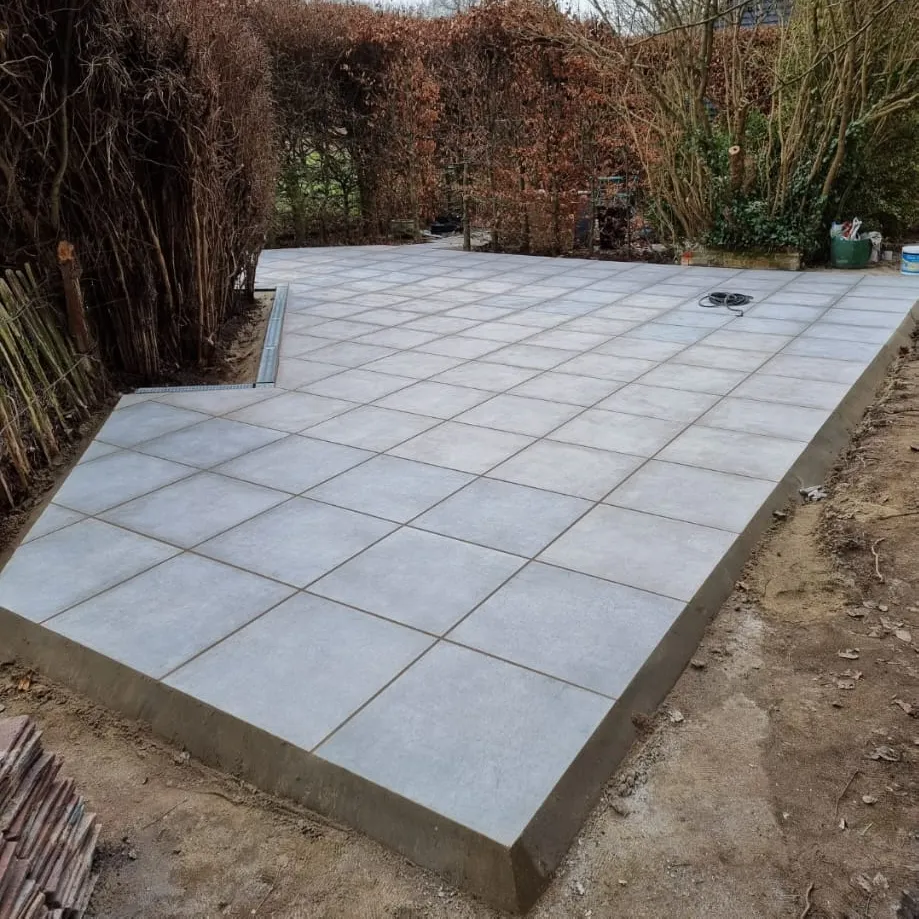
Porcelain paving installation in Ipswich for patios that stay clean and keep their colour. Porcelain is laid on a full mortar bed with primer painted on the back of every slab, which is what stops it lifting later on.
Why Porcelain Stays Looking New
Porcelain absorbs almost no water, so it does not stain from wine, oil or leaf fall and it does not fade in the sun. Moss struggles to get any hold on it. A brush and water is usually all it needs, and it never needs sealing.
More Information
Laying Porcelain the Right Way
Porcelain will not bond to mortar on its own. Every slab needs a slurry primer painted onto the back, then bedding on a full mortar bed with no voids underneath. Spot bedding a porcelain slab leads to cracks and hollow sounding paving.
Cutting and Jointing Porcelain
Porcelain is hard, and it chips if it is cut with the wrong blade. Cuts are made wet with a diamond blade meant for it. Joints are filled with a resin based compound rather than sand and cement, because that stays flexible and does not stain the slab.
About us
Porcelain has gone from a specialist product to one of the most requested patios we lay. Gardenwise Landscaping and Gardening has 25 years of paving experience behind it, and porcelain rewards that, because the laying method is far less forgiving than natural stone. Quotations are free.
25 years landscaping gardens in Ipswich
Free quotation on every job
Landscaping, fencing and paving from one team
Emergency call outs for storm damage
Open seven days a week
STILL NOT SURE?
Frequently Asked Questions
Is porcelain paving worth it in Ipswich?
Porcelain costs more to buy and lay than natural stone, but it keeps its colour, resists stains and needs almost no upkeep. If you want a patio that looks the same in ten years with only a wash down, it is worth the extra. Natural stone suits a softer, weathered look.
Does porcelain paving get slippery?
Outdoor porcelain is made with a textured finish and rated for slip resistance, so it grips well even when wet. It can get slippery if algae builds up in permanent shade, but that washes straight off because nothing soaks into the surface.
Can porcelain paving be laid on sand?
No. Porcelain has to be laid on a full mortar bed over a compacted sub base, with primer on the back of each slab. Laid on sand it moves, rocks and cracks, because the slabs are thin and rely on being fully supported underneath.
Our reviews
Areas we serve
Areas we serve
t: 07389 155306
Opening hours
Mon: 7am - 9pm
Tue: 7am - 9pm
Wed: 7am - 9pm
Thu: 7am - 9pm
Fri: 7am - 9pm
Sat: 8am - 1pm
Sun: 8am - 1pm
Service Areas
Landscape gardener
Fence contractor
Paving contractor
© Copyright 2026. Gardenwise Landscaping and Gardening. All rights reserved.
Address: 64 Spring Road, Ipswich, IP4 2RS